
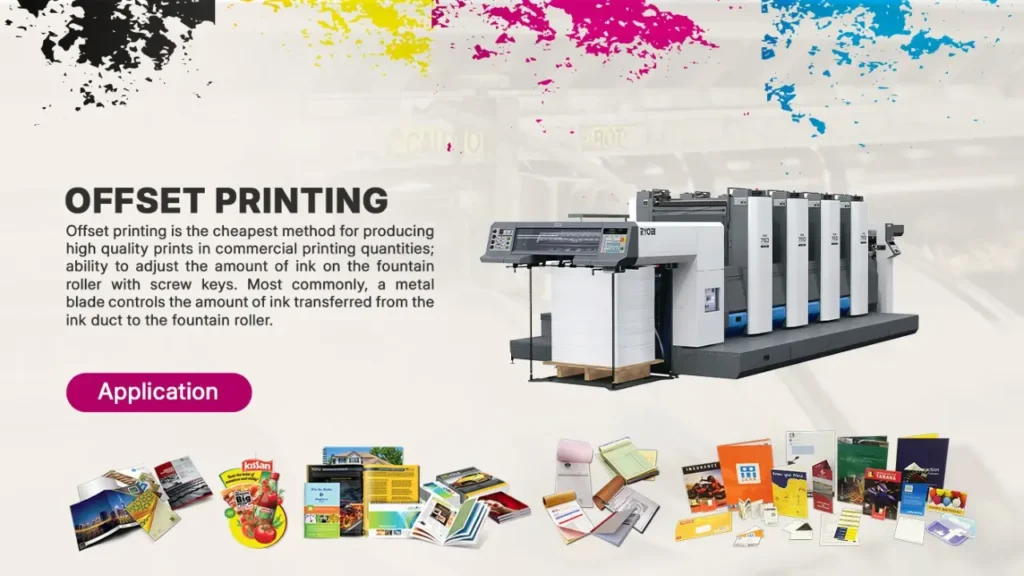
Learn everything about offset printing: how it works, different types, pros and cons, and how it compares to digital printing. Perfect guide for beginners and businesses considering large-volume print jobs.
Printing remains essential in branding, marketing materials, books, packaging, and more—even in this digital age. If you’re considering large print runs, offset printing might be the solution you need. With superior image quality, consistent colors, and cost-efficiency for high volumes, offset printing has been a go-to method for decades.
This guide will cover what offset printing is, how it works, its types, advantages and disadvantages, comparisons with other printing methods (especially digital printing), and tips for choosing the right offset printing setup. By the end, you’ll know if it’s right for your print needs.
What is Offset Printing?

Offset printing, also known as offset lithography, is a printing technique where the image is first transferred from a metal plate to a rubber “blanket” and then onto the printing surface (like paper or cardboard).
Because the paper or substrate never touches the metal plate directly, the plates last longer and the print quality is more consistent.
Example: https://www.techopedia.com/definition/486/offset-printing?utm_source=chatgpt.com
How does the Offset printing Printing Process Work?
Here are the main steps involved:
- Design & Prepress – The artwork is prepared digitally, images separated by color (usually CMYK), proofing is done, and plates are created.
- Plate Making – Plates (often aluminum) are coated so that image areas accept ink and non-image areas reject ink and accept water.
- Inking & Dampening – Ink is applied to the plate. Non-image areas are sprayed with a dampening solution to repel ink.
- Transfer to Blanket Cylinder – The image is transferred from plate → rubber blanket (this is the “offset” stage) → substrate (paper, cardboard, etc.).
- Impression & Drying – Paper goes through impression cylinder which presses it against the blanket for a clean image. After printing, drying or finishing (coating, cutting, binding) is done.
Example: Printing Works
Types of Offset Printing
- Sheet-Fed Offset Printing – Individual sheets of paper are fed into the press. Ideal for high-quality brochures, business cards, stationery.
- Web Offset Printing – Uses rolls of Paper. Often used for Newspapers, Magazines, Catalogues, large runs. More efficient for very high-volume jobs.
- Wet Offset vs Dry Offset – Wet offset uses water/dampening solutions; dry offset does not. Each has its specific uses.
Advantages of Offset Printing

- High image quality, sharp detail, excellent color fidelity.
- Cost-efficient for large volumes (cost per piece becomes lower as quantity increases).
- Wide variety of substrates and paper types can be used: coated, uncoated, textured.
- Ability to use special links and finishes, spot colors, coatings.
- Consistency across large runs; less variation in color/quality.
Disadvantages/Limitations
- High initial setup cost: plate making, machine setup, prepress work.
- Not cost-effective for small quantities or short runs because setup time and cost dominate.
- Longer turnaround time compared to digital printing (due to prepress, drying, finishing).
- Less flexible for variable data printing or jobs needing many personalisations.
Offset Printing vs Digital Printing
| Feature | Offset Printing | Digital Printing |
| Best for large volume | very good for large runs | better for small to medium runs |
| colour matching and fidelity | High | Good, but can vary |
| Setup cost | Higher initial cost (plates etc.) | Low setup cost |
| Cost per unit | Drops sharply with volume | More consistent cost per piece |
| Turnaround time | Longer (Setup+finishing) | Faster for short quantities or quick jobs |
| Customisation | Limited, not ideal | Very flexible |
When should you choose Offset Printing ?
- Printing magazines, newsletters, catalogues in large quantity
- High-quality brochures, books, packaging where color and finish matter
- Projects needing special paper types or coatings
- When consistency across many copies is required
Tips to get the best results with offset printing
- Work with a reliable printer; ask for proof prints before full run.
- Use high-resolution artwork and correct color modes (CMYK, Pantone where needed).
- Choose suitable paper stock for your print job.
- Understand finishing options (varnish, UV Coating, lamination) for durability/look.
- Plan for turnaround time and cost of setup.
- Estimate quantity correctly; too small quantity might make cost per piece high.
Offset printing remains a powerful method for high-quality, large-volume print jobs. With excellent color reproduction, variety of finishing options, and cost efficiency per unit when printing in bulk, it’s still often the best choice for businesses looking for professional printed products.
But it’s not the best for every scenario—if you need something fast, small, or highly personalized, digital printing might be better.
If you have a print job in mind, compare quotes for both offset and digital, check the quality proofs, and choose based on your priorities: cost, quality, turnaround, and flexibility.